Resonant Soft X-ray Scattering (RSXS)

 
In-vacuum Diffractometer

Read more about the technical details on the Advanced Photon Source Website

  • Kappa geometry:
    • -90 < tth < 220
    • -20 < th < 199 (*)
    • -30 < chi < 100
    • -180 < phi <180 (**)
  • Horizontal scattering plane
  • Low vibration close-cycle cryostat: 28K - 400K

(*) Those values are obtained by converting kappa angles (actual motors) into 4-circles angles (pseudo-motors) for extreme cases.
The ranges for the physical motors are: -35 < kth < 289 and -44 < kap < 270.
To make sure the reflection you want to access is within our range, please use the Kappa to 4-circle calculator or contact staff.

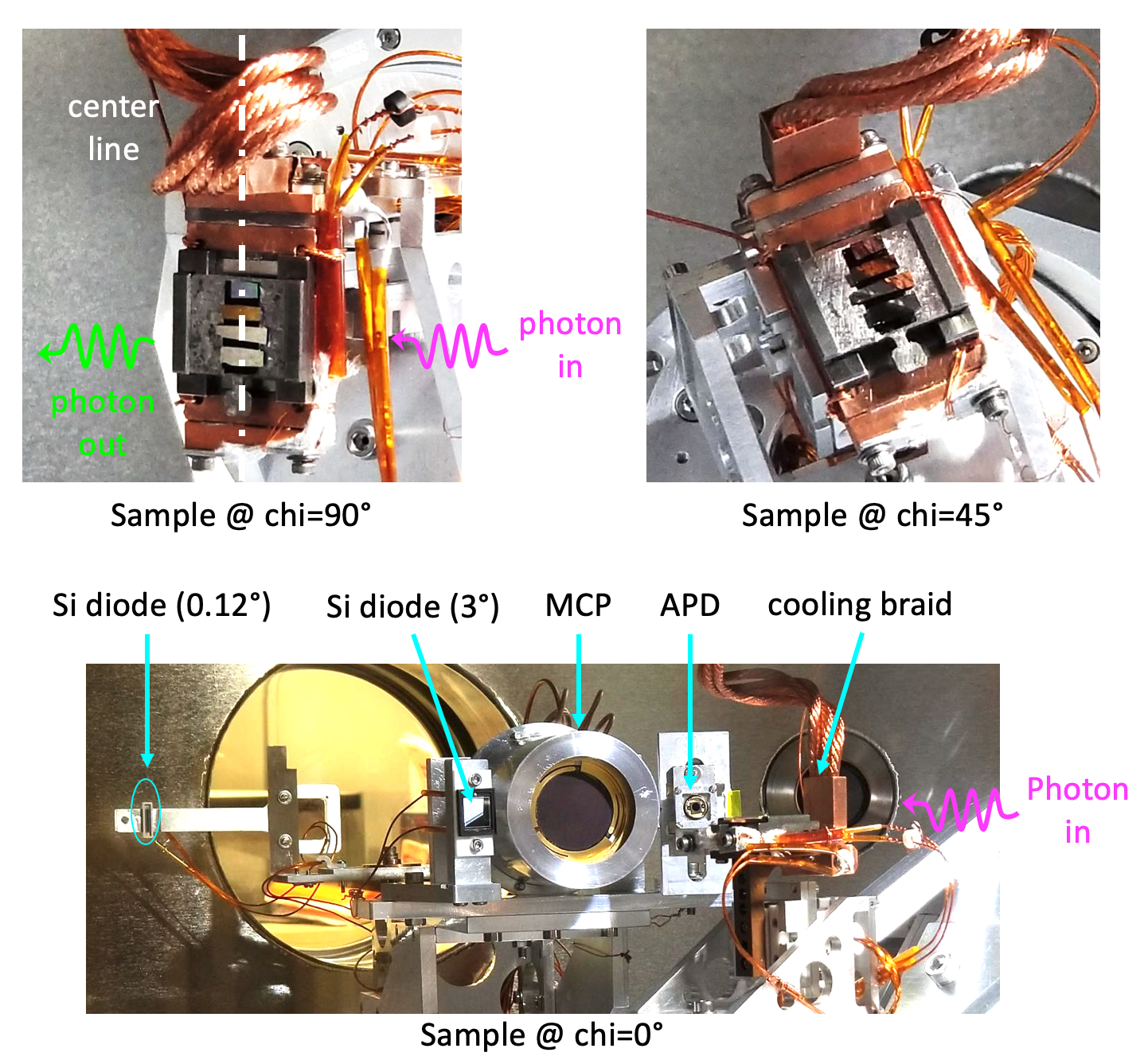
(**) The cooling braid blocks 40 degree of incident/outgoing beam, depending on the configuration (see picture below):

  • in grazing incidence (tth=th =0, chi = 90): -70<phi<70
  • at higher angles, more phi angles are accessible.
 
Detectors
  • Delay-line microchannel plate, area detector
  • Si Photodiodes (x2) with angular acceptance 3 degrees and 0.14 degrees
  • Electron yield detection
 
Sample Mounting
  • Flag Style (Cu, SS or Mo): drawing pdf
  • Reflection geometry
  • You can request sample holders to be shipped to your home institution ahead of time; contact beamline staff and provide a FedEx number.
  • Important: The current set-up uses a kappa geometry with a horizontal scattering plane. Note that a very limited number of diffraction peaks can be accessed in the soft x-ray range (hv < 3keV). This coupled with the fact that conversion to the standard 4-C nomenclature (phi, chi, theta and 2theta) is non-intuitive makes experimental planning crucial. Please consider pre-aligning your sample to speed-up alignment, and contact staff if to make sure the q-range you want to study is accessible. 

 
Kappa Diffractometer