
There are four stages of acceleration involved in creating and sustaining the APS electron beam: the linear accelerator (Linac), the particle accumulator ring (PAR), the booster synchrotron and the electron storage ring.

Electrons are initially emitted from a cathode at one end of the Linac and are accelerated by high-voltage alternating electric fields to 450 million electronvolts (MeV).

The beam from the Linac is injected into the PAR, a small ring of electromagnets, which compresses the long pulse of 10-15 nanosecond electrons down to less than 1 nanosecond. It then cleans the electron bunch to ensure that stray electrons are driven outside the bunch. The beam is then extracted and delivered to the booster synchrotron.

The booster is a racetrack-shaped ring of electromagnets that accelerates the electrons to 6 billion electronvolts (6 GeV) in about half a second, boosting them to more than 99.999999% of the speed of light. The accelerating force is supplied by electrical fields in four radiofrequency (rf) cavities.
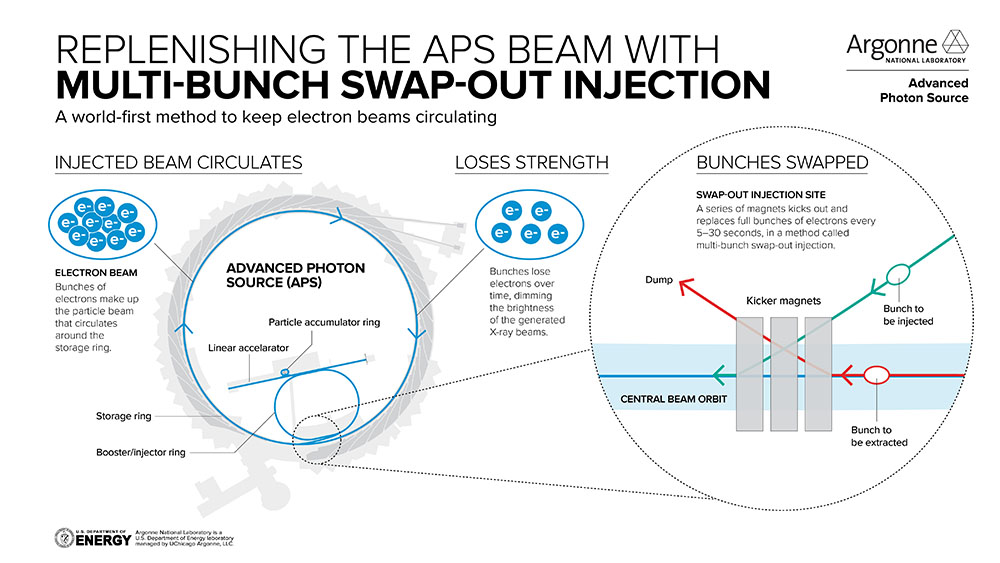
The APS uses an injection method called swap-out to send electrons into the storage ring, a large circle of powerful electromagnets that spans about 2/3 of a mile around. Kicker magnets remove older bunches of electrons and replace them with fresh ones from the booster as the beam circulates in the storage ring.
