This month marks the 130th anniversary of Wilhelm Rontgen’s discovery of X-rays. Like many discoveries, this one was an accident: Rontgen was experimenting with cathode rays when he discovered that applying an electrical current to a vacuum tube caused a fluorescent screen to glow. Further tests demonstrated that these new “X-rays” could pass through most materials and enabled him to obtain images of the bones in his hand. Subsequently, Rontgen won the first Nobel Prize in physics for this discovery, in 1901.
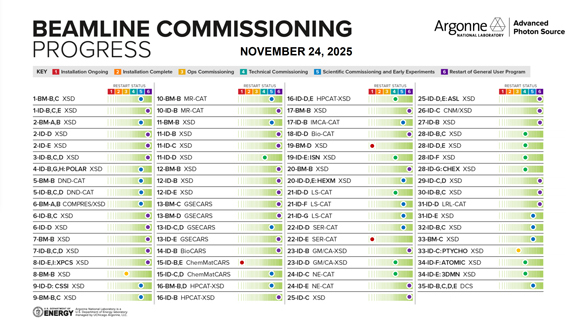
That breakthrough has led to every X-ray experiment conducted over the past 30 years here at the Advanced Photon Source (APS), from first light in 1995 to now, as we head toward the conclusion of the final user run of 2025. We’re still discovering new things that X-rays can do for us, new information about our world that they can uncover. With the upgraded APS running consistently and users returning to the majority of our beamlines, the legacy of that initial discovery continues to be written.
Case in point: Here’s a great story about scientists from Embry Riddle Aeronautical University designing a new device to test materials for hypersonic aircraft at beamline 1-ID. Their creation-in-progress is designed to work with the upgraded X-ray beam at the APS and will simulate the high-temperature conditions that these materials experience as they travel at three to five times the speed of sound.
More new capabilities enabled by the APS upgrade are being utilized by our users every day to explore a wide range of science. Below are some recent photos from the beamlines showing users at 3-ID, 12-ID and 25-ID. The last photo below is special as well – it shows the team working on the installation of the PtychoProbe instrument at 33-ID, the final feature beamline to be installed as part of the APS Upgrade. PtychoProbe will provide the highest spatial resolution of any beamline at the APS and will enable new significant advancements in microelectronics and materials science, just to name a few areas that it will impact.


November in the United States is Thanksgiving month. While we remain thankful for the discovery of X-rays and the incredible scientific advancements that it has enabled over the past century plus, we’re also thankful for all of you, the users who continue to push the boundaries of what is possible to do at an X-ray light source facility such as the APS (and others around the globe). It’s for you that we continue to make the APS a better place, so you can use it to make the world a better place.
As always, keep the APS website bookmarked for the latest news and information. This month you can read a profile of Steve Henke, a data scientist working on methods to deploy seamless data analysis at the APS. Look for more stories and profiles soon.
Until next month,
Jonathan Lang
Interim Deputy Associate Laboratory Director
for Science and Technology
Click on the image below for a larger version.