
Scientists have discovered that the secret to creating exotic forms of silicon lies in a surprisingly elegant principle: density matching.
For years, researchers have explored methods to make unusual crystal structures of silicon that could improve solar panels and electronics. These exotic phases have remarkable properties – one form called r8 silicon could make solar cells far more efficient – but creating them has required crushing silicon under extreme pressures.
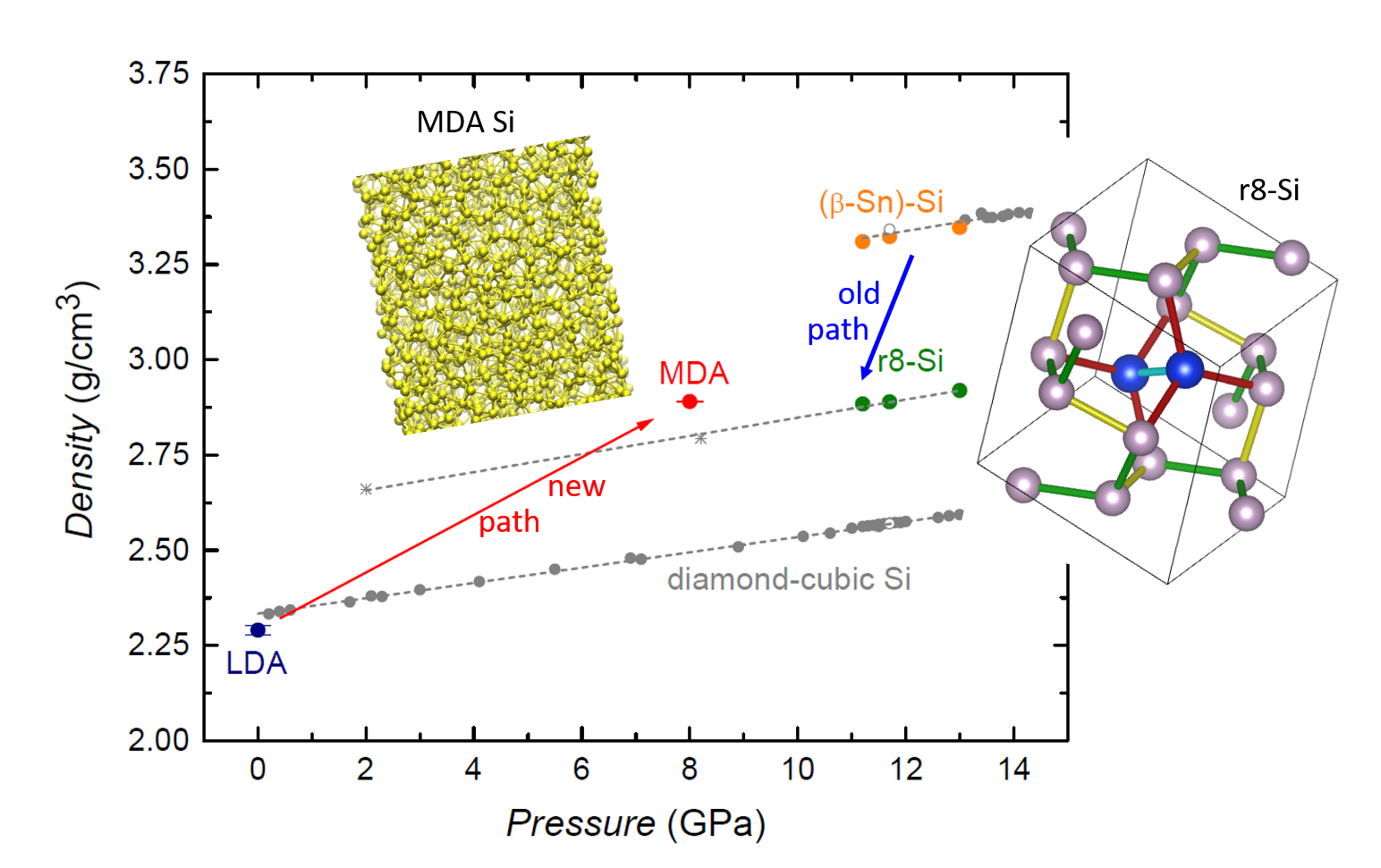
Now, an international team has found a much simpler route by starting with a different form of silicon altogether. Instead of regular crystalline silicon, they used amorphous silicon – a disordered, glassy version of the material. When compressed at room temperature under pressures roughly 25% lower than traditional methods, this jumbled silicon transforms directly into the desired r8 structure.
The breakthrough centers on what the researchers call "density matching" – a phenomenon where materials naturally organize themselves when their densities align perfectly. As the amorphous silicon compresses, its flexible, disordered structure gradually rearranges itself until it reaches the same density as the target r8 crystal phase.
At that critical density point, something remarkable happens. The compressed amorphous material forms what the team calls a "medium-density amorphous" state – essentially a perfectly matched template that guides the silicon atoms into the r8 crystal arrangement. It's like having building blocks that suddenly realize they can fit together in a specific pattern.
The discovery represents the culmination of more than a decade of research, combining sophisticated high-pressure experiments with advanced computer modelling to unlock the secrets of how disordered materials behave under extreme conditions. Using X-ray diffraction at the High-Pressure Collaborative Team (HPCAT) beamline at 16-ID at the Advanced Photon Source, a U.S. Department of Energy (DOE) user facility at DOE’s Argonne National Laboratory, and neutron diffraction at DOE’s Oak Ridge National Laboratory, the researchers measured this density-driven transformation happen in real time. Large facilities such as the APS provide necessary in situ probes capable of monitoring the structural evolution of metastable silicon at atomic scale. This capability led to the discovery of the ordered silicon from a disorder form through density matching.
The key insight is that the disordered starting material has enough structural flexibility to "side-step" the rigid pathways that crystalline materials must follow. The starting amorphous material doesn't need to follow the usual complex pathway through various metallic phases. Instead, the density match creates a direct shortcut to the desired structure. The team demonstrated this density-matching principle works for both silicon and germanium, suggesting it might be a universal pathway for creating exotic materials.
The discovery has significant implications for many applications such as materials for energy generation. Exotic silicon phases like r8-Si could improve photovoltaic efficiency in solar cells by absorbing more of the solar spectrum, potentially making solar energy more cost-effective and accessible. Beyond solar applications, the density-matching approach could enable new materials for extreme environments and quantum sensing. – Jodie Bradby, Bianca Haberl and Guoyin Shen
See: B. Haberl1, M. Guthrie1, G.S. Jung2, L.B.B. Aji3, J.J. Molaison1, G. Shen4, S. Irle2, J.E. Bradby5, “Pressure-driven density match nucleates metastable r8 phases from amorphous Si and Ge,” Mat Today 89, 140-149 (2025)
Author affiliations: 1Neutron Scattering Division, Oak Ridge National Laboratory; 2AComputational Sciences and Engineering Division, Oak Ridge National Laboratory; 3Lawrence Livermore National Laboratory; 4HP-CAT, Argonne National Laboratory; 5The Australian National University.
The authors gratefully thank and acknowledge J.S.Williams (ANU) for many fruitful discussions, S.V. Sinogeikin (HPCAT, APS, now DACTools) for his assistance during X-ray data collection, S. Tkachev (GSECARS, APS) for the gas loading of the symmetric X-ray diamond cell, and R. Boehler (ORNL and HP-TECH) for the diamond anvil preparation for the neutron diamond cell. Portions of this work were funded by Laboratory Directed Research and Development (LDRD) funding, Oak Ridge National Laboratory, United States, and by the Australian Research Council (ARC) under grant number DP230100231. This research used resources at the Spallation Neutron Source, a DOE Office of Science User Facility operated by the Oak Ridge National Laboratory. This research also used resources from the Compute and Data Environment for Science (CADES) at the Oak Ridge National Laboratory, which is supported by the Office of Science of the U.S. Department of Energy under Contract No. DE-AC05-00OR22725. The X-ray diffraction was performed at HPCAT (Sector 16), Advanced Photon Source (APS), Argonne National Laboratory. HPCAT operations are supported by DOE-NNSA’s Office of Experimental Sciences. The gas loading was performed at GeoSoilEnviroCARS (The University of Chicago, Sector 13), Advanced Photon Source (APS), Argonne National Laboratory. GeoSoilEnviroCARS was supported by the National Science Foundation, Earth Sciences (EAR–1634415). The Advanced Photon Source is a U.S. Department of Energy (DOE) Office of Science User Facility operated for the DOE Office of Science by Argonne National Laboratory under Contract No. DE-AC02-06CH11357.
The U.S. Department of Energy's APS at Argonne National Laboratory is one of the world’s most productive X-ray light source facilities. Each year, the APS provides high-brightness X-ray beams to a diverse community of more than 5,000 researchers in materials science, chemistry, condensed matter physics, the life and environmental sciences, and applied research. Researchers using the APS produce over 2,000 publications each year detailing impactful discoveries and solve more vital biological protein structures than users of any other x-ray light source research facility. APS X-rays are ideally suited for explorations of materials and biological structures; elemental distribution; chemical, magnetic, electronic states; and a wide range of technologically important engineering systems from batteries to fuel injector sprays, all of which are the foundations of our nation’s economic, technological, and physical well-being.
Argonne National Laboratory seeks solutions to pressing national problems in science and technology. The nation's first national laboratory, Argonne conducts leading-edge basic and applied scientific research in virtually every scientific discipline. Argonne researchers work closely with researchers from hundreds of companies, universities, and federal, state and municipal agencies to help them solve their specific problems, advance America's scientific leadership and prepare the nation for a better future. With employees from more than 60 nations, Argonne is managed by UChicago Argonne, LLC, for the U.S. DOE Office of Science.
The U.S. Department of Energy's Office of Science is the single largest supporter of basic research in the physical sciences in the United States and is working to address some of the most pressing challenges of our time. For more information, visit the Office of Science website.